
EnergyXP Center For Teachers
These resources are available for teachers to strengthen the EnergyXP (XP) student experience, by offering materials to use before deployment, additional information on expectations during the program, and how to extend energy education engagement and learning after the program.
Prepare For XP - Before The Student Experience
Program Overview
EnergyXP is a mobile education program that brings immersive, hands-on energy education directly to school campuses, for free!
Through a series of interactive learning modules, students explore how energy is produced, transported, and used in everyday life while discovering the science and technology that power the modern energy industry.
EnergyXP has two different track options: the 11-Activity track or 16-Activity track. Both tracks can accommodate up to 50 students per session. We recommend 70-90 minutes per session for the 11-Activity track, depending on student grade level and previous exposure to the concepts covered in EnergyXP. For the 16-Activity track, we recommend 100-120 minutes per session.
During the experience, students participate in a collection of hands-on and digital STEM activities designed to spark curiosity, encourage collaboration, and strengthen critical thinking skills. Each activity connects scientific concepts to real-world applications in the energy sector, helping students understand how classroom learning translates to careers in science, technology, and oil and gas.
XP was designed with educators in mind. Aligned with the Next Generation Science Standards (NGSS) and the 5E Instructional Model, EnergyXP emphasizes curiosity, investigation, and applying knowledge to real-world challenges.
Throughout each activity, students encounter EnergyXP Workforce Avatars, which introduce students to careers that relate to each topic learned. These avatars help students see how STEM skills apply to real professions across the energy industry, and encourage them to begin exploring potential future career pathways.
By combining interactive learning with career exploration, XP helps students build foundational STEM knowledge while gaining a deeper understanding of the energy systems that power our world.
EnergyXP Educator Model
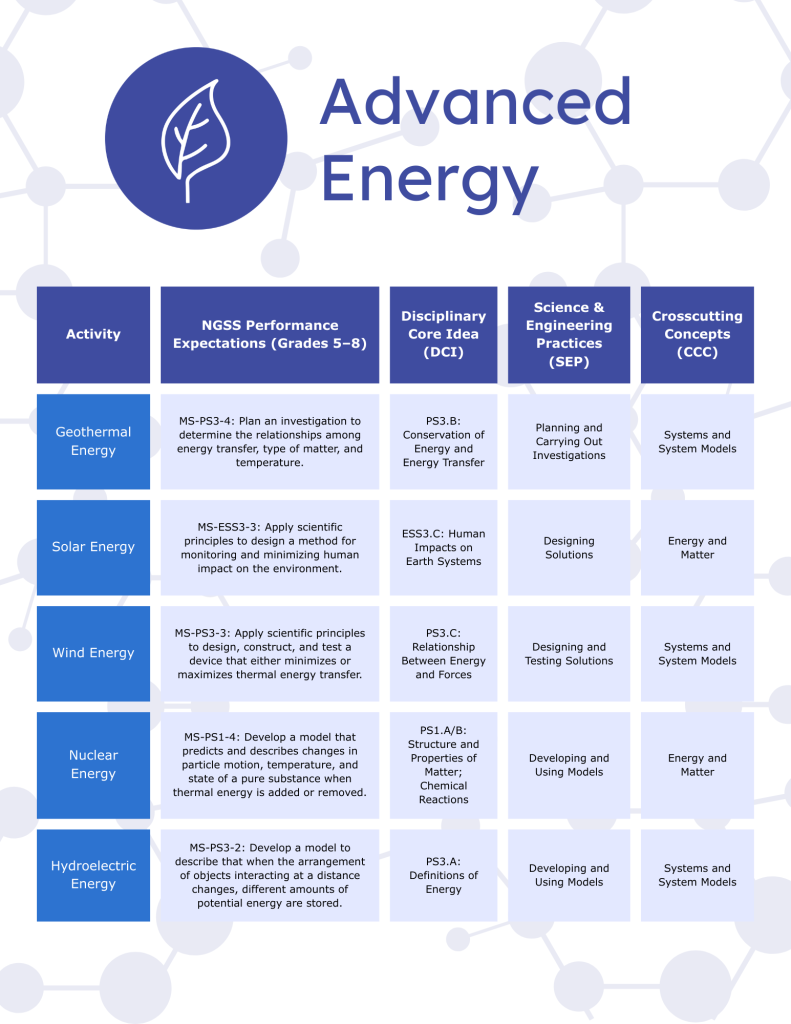
The EnergyXP Educator Model aligns 5th-8th grade students to national educational standards, like the NGSS Performance Expectations, Disciplinary Core Idea, Science & Engineering Practices, and Crosscutting Concepts.



EnergyXP Vocabulary List
- Distill - a way to purify liquids or separate mixtures by heating them into a gas (vapor) and cooling them back into a liquid
- Uranium - a heavy, naturally radioactive, silvery-white metallic element (atomic number 92) found in low concentrations in soil, rock, and water, known for its high atomic weight and its use as an energy source
- Radiation - energy that moves from one place to another in a form that can be described as waves or particles
- Hydrocarbon - natural energy-packed compounds made only of hydrogen and carbon atoms
- Semiconductors - a special material that conducts electricity under certain conditions and blocks it in other conditions
- Conductors - a material or object that allows energy, such as electricity, heat, or sound, to pass through it easily
- Convergent Boundary - places where two or more plates move toward each other
- Divergent Boundary - occurs when two tectonic plates move away from each other
- Transform Boundary - where two tectonic plates slide horizontally past each other
- Fault - a fracture or zone of fractures between two blocks of rock
- Thrust Fault - a break in the Earth's crust where rocky slabs are squeezed together and one side is pushed up and over another at a low angle (<45)
- Reverse Fault - occurs when Earth's crust is squeezed, causing land to push upward at a steep angle (>45)
- Normal Fault - a break in the Earth's crust where rocky blocks pull apart and one side slides downward
- Strike-Slip Fault - a giant crack in the Earth’s crust where two blocks of rock slide past each other horizontally (side-to-side)
- Photovoltaic (PV) cells - a small device that turns light energy into electricity
EnergyXP Enrollment
Enrollment Form
Once EEF has approved the EnergyXP visit request form, we ask each school to complete an enrollment form before we officially coordinate an EnergyXP visit. An EEF staff member will send this to you!
We also ask our schools to provide a Site Contact, who can be there on the day of the visit to assist the EnergyXP facilitator with access to the building and directions to the chosen LGI.
School Schedule
A school schedule is necessary for the day(s) of the EnergyXP visit. The teacher can choose the start and end time for each session, depending on which track was selected. You will submit this information through the enrollment form!
Please be aware that at least one hour is required prior to the first scheduled session, for the EnergyXP facilitator to set up, as well as one hour after the last scheduled session for program breakdown and clean up.
If there are more than three scheduled sessions within one day, please include a 30-minute break for our facilitator.
During The Deployment - Experience Energy In Action
XP Activity Overview & Career Connection
The XP Workforce Avatars connect students to careers that relate to each key energy concept. Use these avatars to encourage students to explore their future career pathways in the energy industry.


EnergyXP Activity Map
We set up EnergyXP in a large-group instruction (LGI) area, like a gymnasium, cafeteria, large classroom, or hallway! EEF unloads XP from the van and rolls it into the LGI area, so the unloading pathway must be free of stairs.
While the set-up may vary depending on the space, the EnergyXP Activity Map illustrates how students could rotate through the program, with 4-7 minutes at each activity, depending on the number of students per session. Two of the XP carts require electricity, so please ensure that two separate points of electricity are available within the space.

Tips For Teachers
- Pre-Assessment
EnergyXP begins with a short pre-assessment to evaluate students’ current familiarity with the topics they will explore during the program. Students are encouraged to make an educated guess if they are unsure of an answer. All student assessment scores are stored anonymously.
- Teacher Supervision
EnergyXP is facilitated by an EnergyXP staff, but teachers are required to remain with their class for the duration of the program.
- Student Groups
Students will be divided into groups up to 4–5 per activity. If you have a preferred method for grouping students (counting off, lining up, etc.), please explain to our EnergyXP facilitator.
- Early Finishers
Some students may complete activities earlier than others, so teachers can help stay engaged by asking what they learned from the activity or which career was connected to it.
- Technical Issues
If a student experiences a technical issue with an activity or iPad, please notify the EnergyXP Facilitator.
- Leaving an Activity
Students should not select the “Do you need to leave early?” button unless instructed. If a student exits an activity and needs help returning, please notify the facilitator.
- Students Arriving Late
Students who arrive late to the program will still be able to participate but may not be able to experience all the activities.
- Encourage Collaboration
While each student completes the activity independently through an iPad, students are encouraged to work within their group and share ideas.
- Connect to Classroom Learning
When possible, help students connect the hands-on activities to science concepts they have learned in class.
- Volunteers
Some EnergyXP sessions may include volunteers who help facilitate the deployment. Volunteers may include teachers, school staff, parents, or professionals from energy companies who assist with guiding students through activities and answering questions.
After the EnergyXP Deployment - Classroom Discussion Guide
These materials are for students who became Energy Experts, and completed EnergyXP! These resources can help students think critically about energy and science education after they experience energy in action with EnergyXP.
Energy Career Exploration
Each activity connects to a real-world career in the energy industry. These careers demonstrate how science, engineering, and technology work together to power our world.
Use the EnergyXP Workforce Avatars below to help students remember the professionals they encountered during the experience and discuss which roles interested them the most.


EnergyXP Reflection Worksheet
This worksheet encourages students to reflect on what they learned during the EnergyXP experience. Students consider how energy systems work, why energy is important, and careers that spark their interest. We encourage you to share your students’ answers with your EEF point-of-contact!
Request Another EnergyXP Visit
Want to book another visit? Complete the EnergyXP Request Form.
